How to Have a Successful Relationship: The Happiness Formula w/ Anil Gupta
So, if I hold a hundred dollar note, I ask you, how much is it worth? How much is it worth?
A hundred dollars?
Yeah, a hundred dollars. And if I say to the note, you're stupid, you're not good enough, you don't belong here, people don't love you, you'll never be successful, you're a failure. How much is it worth?
It's still worth a hundred dollars. It retains its value, no matter what, okay?
So Roberta, if you became the equivalent to this hundred dollar note, no matter what anyone says to you, no matter what happens to you, no matter what, you always retain your value.
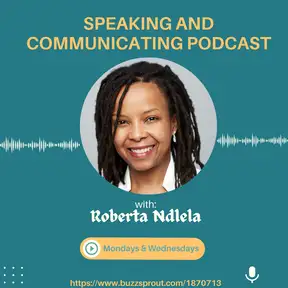
Welcome back to The Speaking and Communicating Podcast. I am your host Roberta Ndlela. If you are looking to improve your communication skills, both professionally and personally, this is the podcast you should be tuning into.
Communication and soft skills are crucial for your career growth and leadership development. And by the end of this episode, please log on to Apple and Spotify and leave us a rating and a review. Now let's get communicating.
Now let's get communicating with our guest today. Joining us from Orlando, Florida, Anil Gupta is known as The Love Doctor. He is a fellow podcaster, a best-selling author twice, a TEDx speaker who helps us have successful relationships.
And before I go any further, please help me welcome him to the show. Hi, Anil.
Hey Roberta, thank you for having me on your show.
My absolute pleasure. Welcome. Why do you think that designing or creating a happiness formula is genuinely going to work and make us happy?
Well, it's not generally going to work.
It's going to work every single time. Because you see, we were never given tools. We were never given a formula.
At school, we're told formulas all the time and then we practice it. But people try and guess and they try and work it out. But what if someone told you at the very beginning, these are the three things you need to work on.
And if you work on those three things, you'll be so much more happier.
So what are those key three things? Because, you know, especially in the self-improvement arena, there are so many things we get bombarded with.
So what are these three key things that you say, if we focused on them, then basically everything will fall into place.
Power of Giving
That's the problem we're bombarded with so much.
That's why this thing really works. And the formula is this. Happiness is equal to G times G times G.
The first G is you have to give your time, your energy, your love, your commitment, your joy, your gift, your money. Give it away. So Roberta, you're giving this podcast away.
That's an act of giving. See, when you perform an act of kindness, an act of giving, you receive endorphins. The person receiving the act of kindness receives endorphins.
The person observing the act of kindness receives endorphins. The person sharing the act of kindness receives endorphins. The person receiving the sharing of the act of kindness receives endorphins.
So it carries on and on and on and on. And we never know what other people are going through. Someone could be suicidal, someone could have an illness in the family, someone may have bad news in the family.
We never know. So it's incumbent on us to give more.
So that's the first one, give. Is it true that when you give or you perform a kind act for someone, you the one who feels, let's use endorphins, you feels more endorphins than the person receiving from you.
Well, it's not a matter of who receives more. It's about capacity. Okay.
So for example, if I help someone across the street, they may say thank you or they may say, Oh my God, I've been stuck there for ages. I prayed to God that someone would help me. You came.
There's two depths of gratitude there, isn't there? There's two depths of feeling there. So it all depends on the individual.
For me, if someone does the smallest act of kindness, my heart is filled because I have a very large capacity. So it's a muscle.
Cultivating Gratitude
Okay.
So the first one is give. You said G times G times G. What's the second G?
The second G is you have to be grateful for what you have.
And don't focus on what you don't have. So can you see what I've got in my hand here?
Is that a watch on your wrist? I have a split here. You have a cast.
Is that a cast?
I have a broken wrist in many places.
Oh, okay.
I was playing pickleball. I slipped and fell and broke my wrist. I looked at it and I immediately knew it was broken.
I was upset for 10 seconds. Then I was grateful.
Was the pain still there?
Oh my gosh. So much pain. I couldn't even move it.
And you still felt gratitude while experiencing pain.
Okay. Take us through that.
That's right. So that was a must that I had developed because I'm used to doing it every day. The reason I was grateful is because it's my non-dominant left hand.
I can still play pickleball with this hand. I can still write. I can still do things with this left right hand.
So I changed my focus. When you change your focus, everything changes. So instead of being upset, I was grateful and that acted as a painkiller.
So gratitude means being grateful for what you have instead of what you don't.
So you don't have the use of your non-dominant hand. You're not going to focus on that. You're going to focus on the fact that your dominant hand is still working perfectly.
That's right.
And I still have everything else. I could have fallen on my head. I could have passed out.
I could have had a concussion. So focus on the good stuff. Because we're good at focusing on the bad stuff.
If you look at this glass, is it half empty or is it half full?
Half full.
Okay. What if I said to you it's refillable? That's a different way to look at it.
You can fill it up anytime you like. And that's what we do in self-development. We can fill it up.
It is.
The reason I was so quick to say half full as well, let me be honest. It's because we always basically get given the two options. Some people look at the glasses half empty.
Some people look at the glasses half full. Always be the half full type of person. Have that perspective.
So for the first time, we now hear you can fill it up.
Okay. So do you ever eat bananas?
Yes, I eat bananas.
But when you peel a banana, how do you peel it?
I don't know if you call it the top, but from the much longer part of the peel.
Yeah, where it's got the stalk.
Yes.
It's the wrong way.
What?
That stalk is your handle. You peel it the other end.
The other end is a little more difficult to peel though.
It's easier. Watch a gorilla. They eat 500 bananas a day.
Oh my word.
They always peel it the other end.
And look how effortlessly they peel.
Yeah.
So there's a different way to look at it. I do seminars and I teach people these little things, and they know there's only one way, there's only one way. Now there's always another way.
There's always another way.
There's always another way.
Embrace Growth
Okay.
So it leads us to the third G.
Yes.
Which is grow. You have to grow emotionally, physically, spiritually, mentally, and financially.
And what does that entail, growing in those departments of your life?
So emotionally, how do you hand on your emotions? Are you always upset? Are you always positive?
Are you always thinking nice thoughts? Are you reactive or are you responsive? Are you kind?
Are you generous? Are you playful? Are you fun?
Do you study? That's mental. Are you a good person?
That's spiritual. Physical, look after your physical wealth, body, eat well, detoxify. Fifth one is financial.
Make sure that you're financially aware of your lifestyle and making sure that you know how to handle money and earn money. See, anytime you're upset, one of those three G's is way below the rest. Do you have bad news?
Normally, that's emotional. Or you haven't given for a while, you get depleted, or you haven't been grateful for a while, you get depleted. So ask yourself, what's your lowest G?
So Roberta, what's your lowest G right now?
Now that I'm trying to look at it differently, I'm not sure when I last actively gave.
That's great. Okay. So just say it's give.
Now all you have to do is give. And you're giving now. But a thank you, a hello, or how are you?
I'm grateful to you. Opening the door for someone, complimenting them is a way to give. It doesn't have to be financial.
So then just perform five random acts of kindness today, and that bucket will be filled.
I wonder, speaking of that, the way you explained it, Anil, because you know how absent-minded we are sometimes. We just go with the flow. Do we actively take the time to notice and realize that those little things we are in the process of giving?
Because even when you go to the shop and you say thank you, and you say have a great day to the cashier, we are in so much of autopilot. I don't think we actually take the time to realize that we are doing that during those moments.
This is where the single most important thing is awareness comes in. So you have to be aware of how you're showing up, how you're not showing up, whether it's authentic. People ask me, how am I?
And I'd say terrible. And they completely ignored me. They're not really asking me.
I just want to test them.
Yeah, because that's not the usual answer. Usually we say I'm fine and then we move.
That's right. But they don't wait for the answer. So awareness gives you clarity, clarity gives you focus, focus gives you action, action gives you results, results gives you momentum which gives you everything.
So we have to be aware of who we're showing up as, what we're saying. Are we genuine? Are we authentic?
Are we sincere? Are we grateful? Are we thankful?
That's where the secrets come in. We have so many distractions, so many things thrown at us. We just have to learn to see what's important.
I want to circle back a little bit on the grow part, because as we said, self-improvement, there's so much information out there.
Doesn't that also create a feeling of, I'm not enough, you know, after listening to this motivational speak, I'm not doing enough, I haven't reached this goal. It's never enough.
Just when I think I've reached this milestone, the next thing comes along. Isn't that counterproductive to how we are supposed to feel about ourselves? So we can be grateful.
The thing is, is we have to be self-worthy.
We have to love ourselves. And it's a muscle. As we develop this muscle, it gets easier and easier and easier.
That's the secret. You know, Michael Jordan, he just got better every day. That's all you have to do.
If you're making progress, you're successful. That's all you have to do is make progress. And you will.
If you continue down this road, be consistent and persistent, everything changes.
Success Redefined
Right.
Now, let's talk about one of the clients that you've coached in the past, Mike Tyson, which a lot of our audience is familiar with. This is a very important question, and this is why I want us to talk about this.
One of the questions you asked him was, what does success mean to you? And Mike Tyson said, for me, it means staying out of jail. And I find that a lot of the time when we talk about success, we think, how much money have I made?
How big is my house? Do I have a better car? I think that is a great example of success means different things to different people.
But I'm not sure if that message is being pushed enough to the general public. What do you think of that?
I totally agree. Totally agree. And if you listen to that interview, he says a lot of very smart things.
He's very heart centered, very caring and very knowledgeable. There may be 15 takeaways just in that three-minute video. And yeah, we're hypnotized in thinking successes around money or stuff.
But success is just seeing your child be happy. Success is just having the ability to have a breakfast with your family. That's a success.
The easier you have a definition for success, the more likely you're achieving it. So if you say, I'll be successful when I have a hundred million dollars in my bank account.
But if we say I'm successful, if I wake up in the morning, oh my God, I'm successful. That's much easier to succeed in. It's much easier to achieve.
So the easier the target, the more successful you will feel. Now I coach some of the richest people on the planet, and they don't feel successful. They don't feel worthy.
They're so fearful of losing it all. You'll be surprised.
Really? And we aspire to be them?
Until you meet them, you think, what have you got to complain about? You can have anything you want, but you can't buy friendship. You can't buy peace.
You can't buy camaraderie.
And when you coach them, when it comes to happiness, because they already have the money, do you find that just because they've reached that level of success, it then becomes more challenging to have these genuine friendship bonds, genuine
relationships, sincerity from other human beings? Because you know, as they say, it's lonely at the top.
What tends to happen? They tend to stay friends with their long-term friends, the people they were friendly with before they got successful.
Right.
Whereas the newer friends, they don't know, are you being my friend because I'm successful? Are you being my friend because you want something from me? So they don't know that.
And people are very good at faking it. So they tend to keep long-term friendships through the period where they weren't successful. They tend to keep and spend time with those people because they've been there in thick and thin.
Lasting Relationships
Now let's talk about relationships.
That is one aspect of our lives, especially romantic ones, where most people live challenges.
Now that we've spoken about the three Gs, does that mean that if each individual person actively lived according to gratitude, growth, and giving, that it then transforms into having successful relationships with others?
No. I'm just playing with you. I'm just playing with you.
But the thing is this, do you know why relationships fail?
Yeah.
Tell me.
No, I'm waiting for the answer.
Okay. So the relationship fail rate is 90 percent, okay? So before people get married, they've had four or five relationships.
Of course.
Okay.
Each time they thought this is the one, this is the one, this is the one, this is the one. But every single time they fail and eventually they get married, but they don't know why that person is the right one. They think that it's just a feeling.
And then after marriage, it's a 50, 60 percent divorce rate. The second marriage is a 60 to 70 divorce rate. Because they don't collect the data, they don't make an informed choice, they haven't done their due diligence.
So people say yes to a relationship until it becomes a no, which is insane because they spend more time looking at a house, a car than they do in finding the right partner.
So they'll meet someone, they'll have a few drinks and they get on well, think, oh, she must be the one. You've got to have three criteria in any relationship. Number one is integrity.
Number two, they must be loving. And number three, they have to be healthy, emotionally, physically, spiritually, mentally, financially. So most people don't do that due diligence.
They think, oh, I will work it out. Love will conquer all. No, don't do that.
My first marriage, 37 years and eight days. My daughter married the first boyfriend because she used the formula. And they will never divorce, never ever will never happen because they have the integrity, loving and healthy.
It's a game changer, Roberta.
And we really want to know Anil, because a lot of us, we do aspire to have those kinds of relationships, healthy relationships and loving relationships. But here's the thing back to what you just said.
When you just meet someone and you start thinking, oh my goodness, look at houses and everything. But isn't that you being hopeful, you entering into this union with the best intentions?
Because you're not saying I'm entering into this because I wanted to fail.
I don't believe people have the best intentions. When people date, each person shows up the best version of themselves. They just want to get to the next stage, the next stage and the next stage.
I don't think that that's a good thing. You know, what the intent isn't always pure, yeah? Whereas if you get to know the person first before you date, then it's just data collection.
There's no emotion. But once you get emotional, that's when you make the wrong decisions. Oh, I will change him.
He will change. No, you know that.
But people don't.
Well, they just focus on the good stuff. Oh, he's so good looking. He's this and don't do that.
The loving part.
How do you identify a person's behavior and say, wait a minute, when they do this, I can see that they are a loving person.
Because I think when it comes to love, there are so many mixed signals and misunderstandings on what it really means to be loving, especially nowadays.
Well, it honestly is quite simple. So you go to a restaurant. So I have to itch.
You go to a restaurant. How do they treat the waiter? How do they treat people around them?
How do they treat anyone? How do they talk to their mothers? How do they talk to their fathers?
How do they talk to their nieces and nephews? If they've got kids, how do they talk to their kids? How do they talk to their employees?
Is it different when they speak to you? Is it worse when they speak to someone else? What are the kind, loving actions?
Do they hold the door for other people? Did they say thank you? Do they show up nicely?
These are things you collect the data, call it ABCD, always be collecting data. Never believe what they say to you without confirming it. I'm going through a divorce.
What does that mean? Have you started the divorce? Is it towards the end?
Is it in the middle? How many more years? We're going to get divorced soon.
What does that mean? You have to collect the data. Are you in the final settlement?
You have to ask these questions. So, for example, I'm on a dating site, you're on a dating site, and on my dating site, I say I love dogs. You want to impress me, you're going to lie to me.
So, let's role play. I'll ask you, hey, Roberta, do you like dogs?
Oh, yeah. I think they're cute.
What's your favorite dog?
A lab.
How many labs have you owned?
I'm from South Africa. We usually don't keep pets around the house, but I wouldn't mind having one.
Oh, so you never had a dog?
Not really. It's a cultural thing.
But when you say not really, is that a no or is that a yes?
No, never had a dog.
Okay. So can you see, there's a little bit of uncertainty there. You've got the thing, I'm from South Africa.
Yeah. But if you didn't say that, and they say, oh, what's your favorite dog? They say, brown one.
You know they're lying. Or how many dogs have you owned? None.
Now ask me the same question. Do you like dogs?
Okay. Anil, do you like dogs?
Roberta, I absolutely love dogs. Can I show you the photo of one of my dogs?
Oh, please. Yes, go ahead.
This is Poodles and this is Roxy. Oh my God, they're so cute.
Very cute. Yes.
Okay. So you know I'm telling the truth. I'm proactive around it.
You asked me, do you like dogs? I said, no, I love dogs. So you know that I'm passionate about something.
So this is data that you need to collect. How do they show up? How energetic are they?
How powerful are they? If they say, yeah, I love my parents. How often do you speak to them?
Well, whenever I can. Really?
Whenever you can. Which is how often?
Which is how often? Yeah. Great question.
Well, you know, I speak to my mom once a month and my dad, you know, whenever he's around, as opposed to, oh, I speak to my mom every single day. Oh my God, we get on so well. What about your dad?
Then the energy drops. That this is data you have to collect. You have to be a little bit of a sleuth, but it's your life.
Why would you risk your life with something that you could have found out earlier on?
Are these the questions your daughter was asking her now husband?
Well, no, she asked it. Yeah, because they were getting to know each other. But she just showed how he showed up.
How kind was he? How consistent was he? How persistent was he?
How aligned was he? I said, whatever you do, don't marry a doctor. What is she going to do?
Marry a doctor.
Any particular reason, did Anil that she gave her that kind of advice?
Well, doctors tend to be very passionate about their work. So they work very long hours and they may not give her the attention that she wants. That's the reason why.
And the nurses.
That makes sense. And as the love doctor, of course you would know.
Yes, because here's the thing, speaking of consistency, I think when we were practicing the dog part, the thing about consistency, and I know a lot of dating coaches have warned us women with regards to, because we get so quickly emotional,
especially if the guy is good looking and whatnot. We don't notice those little things that if he said he loved dogs, when we first met two months ago, is he still displaying that kind of behavior? Is he still talking about poodles?
If something excites us about a guy, I think a lot of us do lose track, kind of, when it comes to noticing those little things. Is he consistent? Does he do what he says he's going to do?
Yeah, integrity.
If you're in a restaurant and he says, hey, I'm in a business meeting right now, can I call you back? He's lying in front of you.
Because he's not in a business meeting.
Yes.
But also, if we flip it, if he says to you, I'm going to call you if you are supposed to have an eight o'clock phone call, I'm going to call you at eight.
And then he says he's in a business meeting and he doesn't call you back, then that's also inconsistent behavior, right?
Yeah, it's not aligned. Not being your word.
Do you have any of your clients when they come to you looking for this type of coaching? Do any of them have the sphere that, Anil, you know what, the dating pool, there's not a lot to pick from. Maybe I can shed some things.
Maybe I can pick like 70% of what's good, the 30% we can figure out as we go along.
Well, whenever someone works with me, they never pick the wrong partner ever. That is 99% of the safety of working with me. But the thing is this.
So if you went fishing, there's a big lake. Where would you go? You would go where the fish are, correct?
That's what people need to do. If you're looking for a man, say you go where the type of man you want would hang out. It's not the bar.
It's not the discotheque. It's not the nightclub. It may be the rotary club.
It could be the pickleball club, the tennis club, the social club, the golf club, Kiwanis, Lions Club, whatever. But you have to go where your guy, a woman, would hang out. That will increase your chances.
I get people from New York, Chicago, LA saying, oh, all the good men are married or gay. I said, your problem is-
That's in America.
Yeah. I said that your problem isn't finding the right guy. You're just looking in the wrong place.
And I teach them where to look, how to look, how to filter, what to say to them, so that they never make that mistake.
And so that they don't waste time with time wasters.
That's right. And with women, there is a biological clock. They'll say, you know, start with a relationship.
Yeah, I want children. I want children. And later on, no, I don't want children.
Then they sort of spent, I spent four years with you. What's going on? Then they settle.
No, don't do that. Make the decision early by collecting as much data as possible. And if he says he loves children, but then he's like this with children, it's not aligned.
Always look at the behavior.
Yes.
How do they show up?
And then one last thing that I'm hoping would help us with is we tend to have a sense of or a feeling of unworthiness in one aspect or another.
Inherent Worth
How do we overcome that? Because I think when we show up and we feel that way about ourselves, that's the energy we show up with. And it's almost like the people around us have these antenna and they can feel that you're not confident on who you are.
And sometimes they do take advantage of that. So how can we break that pattern?
And we can do it in three minutes.
Oh, okay.
So if I hold a hundred dollar note, I ask you how much is it worth? How much is it worth?
A hundred dollars?
A hundred dollars. And if I say to the note, you're stupid, you're not good enough, you don't belong here, people don't love you, you'll never be successful, you're a failure. How much is it worth?
It will feel it's worth less than the hundred, and what it can buy for the hundred.
Who told you that?
That's BS. You know what BS is?
Yes.
It's belief system.
Right. Right. Yeah.
Okay.
You have a belief system that the value diminishes. It doesn't change. It's still worth a hundred dollars.
It's still worth a hundred dollars, yes.
And you can still buy whatever is worth a hundred dollars in the marketplace. But us humans have this thing that, oh, because...
No, no, no, no, no, no, no, no, no, no, no. It retains its value no matter what. Okay?
So Roberta, if you became the equivalent to this hundred dollar note, no matter what anyone says to you, no matter what happens to you, no matter what, you always retain your value. Now, this hundred dollar note is actually worth millions of dollars.
Can I explain to you why?
Please do.
I can go to a store, buy a hundred dollars worth of goods. That same hundred dollars can buy another hundred dollars worth of goods. That same hundred dollars can buy another hundred dollars worth of goods.
And it continues forever. Can you see why it's priceless?
It multiplies, yes.
Yeah. So Roberta, wherever you go, you bring value. You're priceless.
You're worthy.
We are priceless and worthy. Those are words of wisdom from the love Dr. Anil Gupta, who is a podcaster, TEDx speaker and a bestselling author twice.
Anil, I believe you have a freebie for us that we can tap into on your website.
Yeah. If you go to meetanil.com, there are some many resources that you can have for free that will inspire you to live a richer for a happier life.
meetanil.com for the freebies. Thank you very much for sharing those with us. My pleasure.
And is that the website where our listeners can find you if they want to reach out to you?
Yeah. You can book a call with me if you're struggling in your relationships, happy to help you, free resources and great content.
Also on meetanil.com.
That's perfect. Thank you for a wonderful interview Roberta.
I had fun as well. Thank you for sharing these strategies with us. Very, very helpful.
We appreciate you, Anil. Thanks.
No, thank you. Thank you. Thanks everyone.
Bye.
Bye. Don't forget to subscribe, liberating and to review on Apple and Spotify, and stay tuned for more episodes to come.